6 minutes
Microbenchmarking Go: Bytes vs. Runes and the Hidden Cost of Map Keys
While working through the Go track on Exercism.org, I ran into an interesting performance puzzle in the Nucleotide Count exercise. It looked simple at first glance, but it sent me down a rabbit hole of microbenchmarking that revealed an insight beyond just how you iterate over strings.
The Initial Question: Bytes or Runes?
The input is a DNA sequence, which contain only ASCII characters like A, C, G, and T. Naturally, I reached for a map to count each nucleotide.
With that set up, I added the iteration over the string using byte indexing (for i := 0; i < len(s); i++), since I remembered a comment on r/golang suggesting that byte iteration is idiomatic and efficient for ASCII-only strings.
package dna

import (
  "fmt"
)

type Histogram map[byte]int

func NewHistogram() Histogram {
  return Histogram{'A': 0, 'C': 0, 'G': 0, 'T': 0}
}

type DNA string

func (d DNA) Counts() (Histogram, error) {
  h := NewHistogram()

  for i := 0; i < len(d); i++ {
    if _, ok := h[d[i]]; !ok {
      return nil, fmt.Errorf("invalid nucleotide %q in DNA strand", d[i])
    }
    h[d[i]]++
  }

  return h, nil
}
A Surprising Benchmark Result
One of my favorite parts of Exercism is reviewing other submissions and comparing microbenchmark results. This time, I noticed that a solution by bobahop actually used rune iteration (for _, r := range s) and surprisingly, outperformed mine in microbenchmarks.
That caught me off guard. Had I been misled by Reddit?
I assumed that rune iteration would be slower due to the UTF-8 decoding overhead. I also knew my version was slower than bobahop’s due to using map lookups, while his used a switch, so I tested his version with byte iteration instead. Even then, his rune-based solution remained faster, just as he had noted on Exercism.
package dna

import "fmt"

type Histogram map[byte]int

type DNA string

const (
  nucA byte = 65
  nucC byte = 67
  nucG byte = 71
  nucT byte = 84
)

func (dna DNA) Counts() (Histogram, error) {
  results := Histogram{nucA: 0, nucC: 0, nucG: 0, nucT: 0}
  length := len(dna)
  for i := 0; i < length; i++ {
    nuc := dna[i]
    switch nuc {
    case nucA, nucC, nucG, nucT:
      results[nuc]++
    default:
      return nil, fmt.Errorf("invalid nucleotide '%c'", nuc)
    }
  }
  return results, nil
}
My Initial Approach
To get to the bottom of this, I created a small repo to isolate and benchmark different implementations using both byte and rune iteration.
I started with a simpler function: transcribing DNA to RNA.
func TranscribeDnaToRnaBytes(dna string, rna []byte) {
  for i := range len(dna) {
    switch dna[i] {
    case 'A':
      rna[i] = 'U'
    case 'C':
      rna[i] = 'G'
    case 'G':
      rna[i] = 'C'
    case 'T':
      rna[i] = 'A'
    }
  }
}

func TranscribeDnaToRnaRunes(dna string, rna []rune) {
  for i, n := range dna {
    switch n {
    case 'A':
      rna[i] = 'U'
    case 'C':
      rna[i] = 'G'
    case 'G':
      rna[i] = 'C'
    case 'T':
      rna[i] = 'A'
    }
  }
}
As expected, the benchmarks showed that byte iteration was slightly faster than rune iteration.
$ go test -bench='^(BenchmarkTranscribeDnaToRnaBytes|BenchmarkTranscribeDnaToRnaRunes)$' -benchtime=1000000x -benchmem
goos: linux
goarch: amd64
pkg: github.com/pessolato/strmapmicrobench
cpu: 12th Gen Intel(R) Core(TM) i9-12900F
BenchmarkTranscribeDnaToRnaBytes-24      1000000               331.4 ns/op             0 B/op          0 allocs/op
BenchmarkTranscribeDnaToRnaRunes-24      1000000               529.3 ns/op             0 B/op          0 allocs/op
Then I rewrote the nucleotide count functions, simplifying and updating them. I also used a more idiomatic byte loop (for i := range s) to see if that would help.
func CountNucleotidesByByteIndex(dna string) map[byte]int {
  chars := make(map[byte]int)
  for i := range len(dna) {
    chars[dna[i]]++
  }
  return chars
}

func CountNucleotidesByRuneRange(dna string) map[rune]int {
  chars := make(map[rune]int)
  for _, r := range dna {
    chars[r]++
  }
  return chars
}
But the performance difference persisted.
$ go test -bench='^(BenchmarkCountNucleotidesByByteIndex|BenchmarkCountNucleotidesByRuneRange)$' -benchtime=1000000x -benchmem
goos: linux
goarch: amd64
pkg: github.com/pessolato/strmapmicrobench
cpu: 12th Gen Intel(R) Core(TM) i9-12900F
BenchmarkCountNucleotidesByByteIndex-24          1000000              5191 ns/op             192 B/op          2 allocs/op
BenchmarkCountNucleotidesByRuneRange-24          1000000              1682 ns/op             192 B/op          2 allocs/op
PASS
ok      github.com/pessolato/strmapmicrobench   6.876s
At this point, I realized the bottleneck might not be the loop. So I turned to profiling.
CPU Profiling Tells the Real Story
I profiled both versions of the counting function and things started to click.
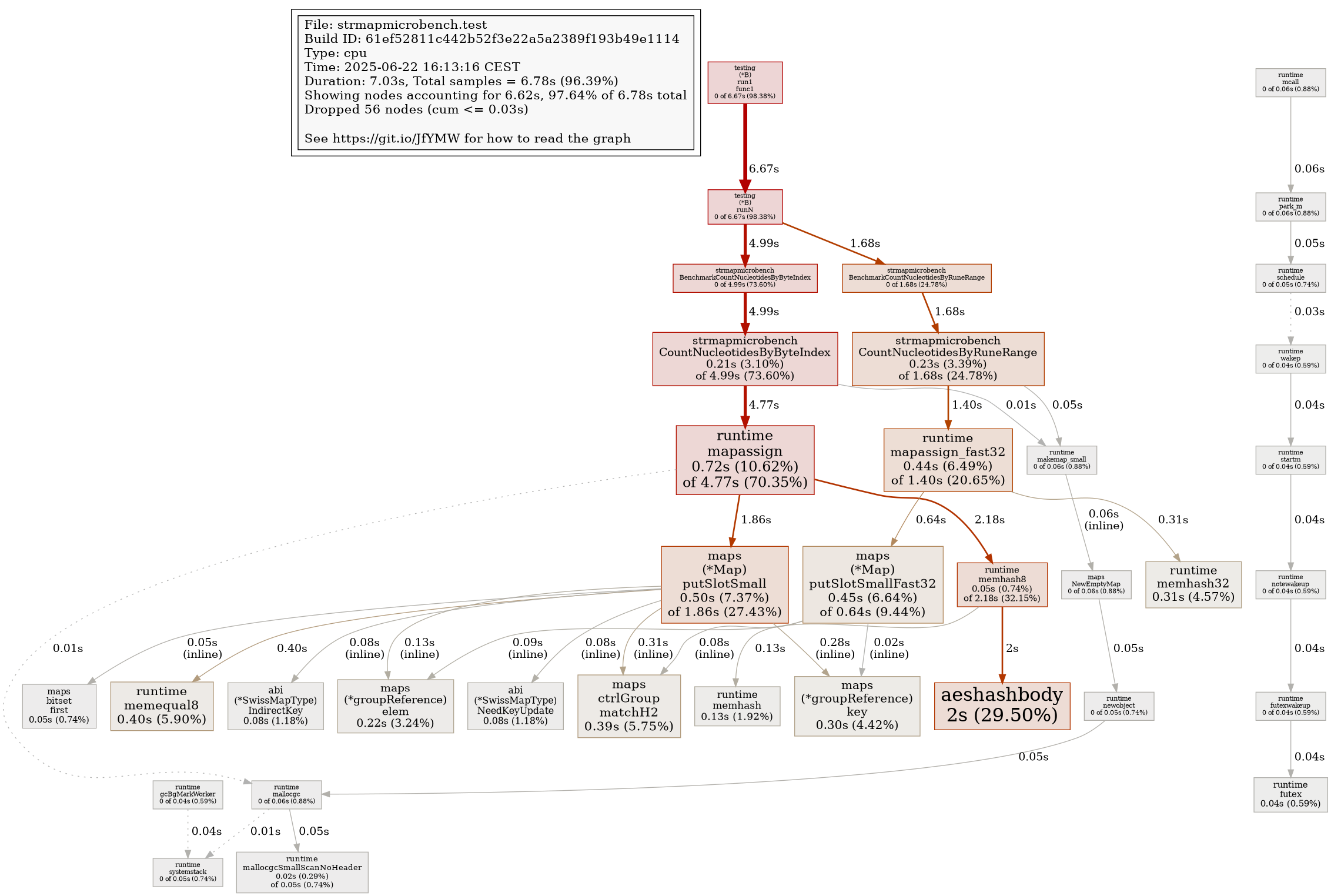
The version using byte indexing was calling the generic mapassign function, while the rune-based version was using mapassign_fast32, which is much faster.
That was the aha moment. The real issue wasn’t string iteration, but how maps work under the hood, especially based on the key type.
Go’s Internal Map Implementations
The Go runtime uses different internal implementations for map operations depending on the key type:
- For smaller key types like
byte, it uses the slower genericmapassign. - For
int32(whichruneis an alias of), it uses optimized versions likemapassign_fast32.
So, despite rune iteration having more overhead, the faster map operations made the overall function faster.
To test this theory further, I added two more functions: one that uses byte iteration but casts to int16, and another that casts to rune:
func CountNucleotidesByByteIndexAsRune(dna string) map[rune]int {
  chars := make(map[rune]int)
  for i := range len(dna) {
    chars[rune(dna[i])]++
  }
  return chars
}

func CountNucleotidesByByteIndexAsInt16(dna string) map[int16]int {
  chars := make(map[int16]int)
  for i := range len(dna) {
    chars[int16(dna[i])]++
  }
  return chars
}
Benchmark results:
$ go test -bench='^BenchmarkCountNucleotidesBy.*$' -benchtime=1000000x -benchmem
goos: linux
goarch: amd64
pkg: github.com/pessolato/strmapmicrobench
cpu: 12th Gen Intel(R) Core(TM) i9-12900F
BenchmarkCountNucleotidesByByteIndex-24                  1000000              5177 ns/op             192 B/op          2 allocs/op
BenchmarkCountNucleotidesByByteIndexAsRune-24            1000000              1648 ns/op             192 B/op          2 allocs/op
BenchmarkCountNucleotidesByByteIndexAsInt16-24           1000000              5132 ns/op             192 B/op          2 allocs/op
BenchmarkCountNucleotidesByRuneRange-24                  1000000              1670 ns/op             192 B/op          2 allocs/op
PASS
ok      github.com/pessolato/strmapmicrobench   13.631s
Interestingly, int16 didn’t get any runtime optimization. But casting bytes to rune actually performed better than the native rune iteration, because byte iteration is inherently faster, and rune still benefits from optimized map handling.
Final Optimization: Arrays and Switches
Now that I understood the map overhead, I tried a more aggressive optimization. Since the nucleotide set is small and known, I replaced maps with a fixed-size array and a switch statement.
func CountNucleotidesArrayBytes(dna string) map[byte]int {
  chars := [4]int{}
  for i := range len(dna) {
    switch dna[i] {
    case 'A':
      chars[0]++
    case 'C':
      chars[1]++
    case 'G':
      chars[2]++
    case 'T':
      chars[3]++
    }
  }
  return map[byte]int{
    'A': chars[0],
    'C': chars[1],
    'G': chars[2],
    'T': chars[3],
  }
}

func CountNucleotidesArrayRunes(dna string) map[rune]int {
  chars := [4]int{}
  for i := range dna {
    switch dna[i] {
    case 'A':
      chars[0]++
    case 'C':
      chars[1]++
    case 'G':
      chars[2]++
    case 'T':
      chars[3]++
    }
  }
  return map[rune]int{
    'A': chars[0],
    'C': chars[1],
    'G': chars[2],
    'T': chars[3],
  }
}
And the benchmarks:
$ go test -bench='^(BenchmarkCountNucleotidesArray.*|BenchmarkCountNucleotidesByByteIndexAsRune)$' -benchtime=1000000x -benchmem
goos: linux
goarch: amd64
pkg: github.com/pessolato/strmapmicrobench
cpu: 12th Gen Intel(R) Core(TM) i9-12900F
BenchmarkCountNucleotidesByByteIndexAsRune-24            1000000              1642 ns/op             192 B/op          2 allocs/op
BenchmarkCountNucleotidesArrayBytes-24                   1000000               412.9 ns/op           192 B/op          2 allocs/op
BenchmarkCountNucleotidesArrayRunes-24                   1000000               680.5 ns/op           192 B/op          2 allocs/op
PASS
ok      github.com/pessolato/strmapmicrobench   2.739s
The result? Substantial performance gains, thanks to completely bypassing map lookups.
Conclusion
This whole detour was a great reminder: Always benchmark and profile when performance matters. Micro-optimizations like using bytes over runes can help, but they pale in comparison to the deeper costs of how your data structures behave at runtime.
Key Takeaways
- Byte iteration is slightly faster than rune iteration.
- Map key type matters a lot—Go uses specialized fast paths for certain types.
- Profiling is essential for spotting unexpected performance bottlenecks.
- When the key space is small and fixed, arrays + switch can outperform maps significantly.
If you’re curious, you can find all the code and benchmark results here: https://github.com/pessolato/strmapmicrobench